Car Wheel Alignment Cost Calculator (2026)
A standard wheel alignment costs $50 to $100 for 2-wheel (front-end) service and $100 to $200 for a full 4-wheel alignment at most shops in 2026. Dealerships and luxury vehicles push these ranges higher, and ADAS sensor recalibration can add $100 to $500 on newer models. Use this calculator to compare alignment types, shop options, and add-on services before booking.
Showing national averages
Loading calculator…
Updated March 2026 · Pricing assumptions reference RepairPal, Kelley Blue Book, J.D. Power, Firestone, Pep Boys, Jerry.ai, Tire Genius, and AAA guidance reviewed on March 4, 2026.
Average Wheel Alignment Costs by Type
The type of alignment your vehicle needs is the biggest factor in base cost. Most modern cars with independent rear suspension need a 4-wheel alignment, while older trucks and vehicles with solid rear axles may only need front-end service. Performance alignments use tighter specifications and take longer, which increases both labor and equipment time.
These ranges represent baseline pricing before vehicle class, shop type, suspension condition, and regional adjustments. The calculator above applies all of these factors to produce a more specific estimate for your situation.
| Alignment type | Low | High | When it applies |
|---|---|---|---|
| Front-end (2-wheel) | $50 | $100 | Adjusts front wheels only. Best for vehicles with solid rear axle or when only front angles are out of spec. |
| 4-wheel alignment | $100 | $200 | Adjusts all four wheels. Required for most modern vehicles with independent rear suspension. |
| Thrust angle | $70 | $120 | Corrects rear axle geometry relative to front centerline. Often needed after rear-end impacts. |
| Performance alignment | $150 | $300 | Tighter tolerances and custom specifications for sport driving or track use. Requires specialized equipment. |
How Vehicle Class Changes Alignment Cost
Vehicle weight, suspension complexity, and component size all affect how long an alignment takes and what equipment is required. Compact cars are straightforward, while trucks with 4WD systems and luxury vehicles with adaptive suspension need more time and precision. This is why a friend's alignment quote for a Honda Civic does not apply to your Ford F-150 or BMW X5.
| Vehicle class | Planning multiplier | Practical context |
|---|---|---|
| Compact | About 0.90x to 0.95x | Lighter weight and simpler suspension geometry typically keep alignment costs below midsize baseline. |
| Mid-size | 1.00x baseline | Used as the neutral anchor due to broad market coverage and standard parts availability. |
| SUV / crossover | About 1.10x to 1.20x | Heavier weight and larger suspension components increase equipment time and service complexity. |
| Truck | About 1.15x to 1.25x | Full-size trucks with 4WD or heavy-duty suspension require more adjustment time and specialized equipment. |
| Luxury / performance | About 1.30x to 1.50x | Specialty suspension systems, tighter tolerances, and potential ADAS requirements drive costs higher. |
What Camber, Caster, and Toe Actually Mean
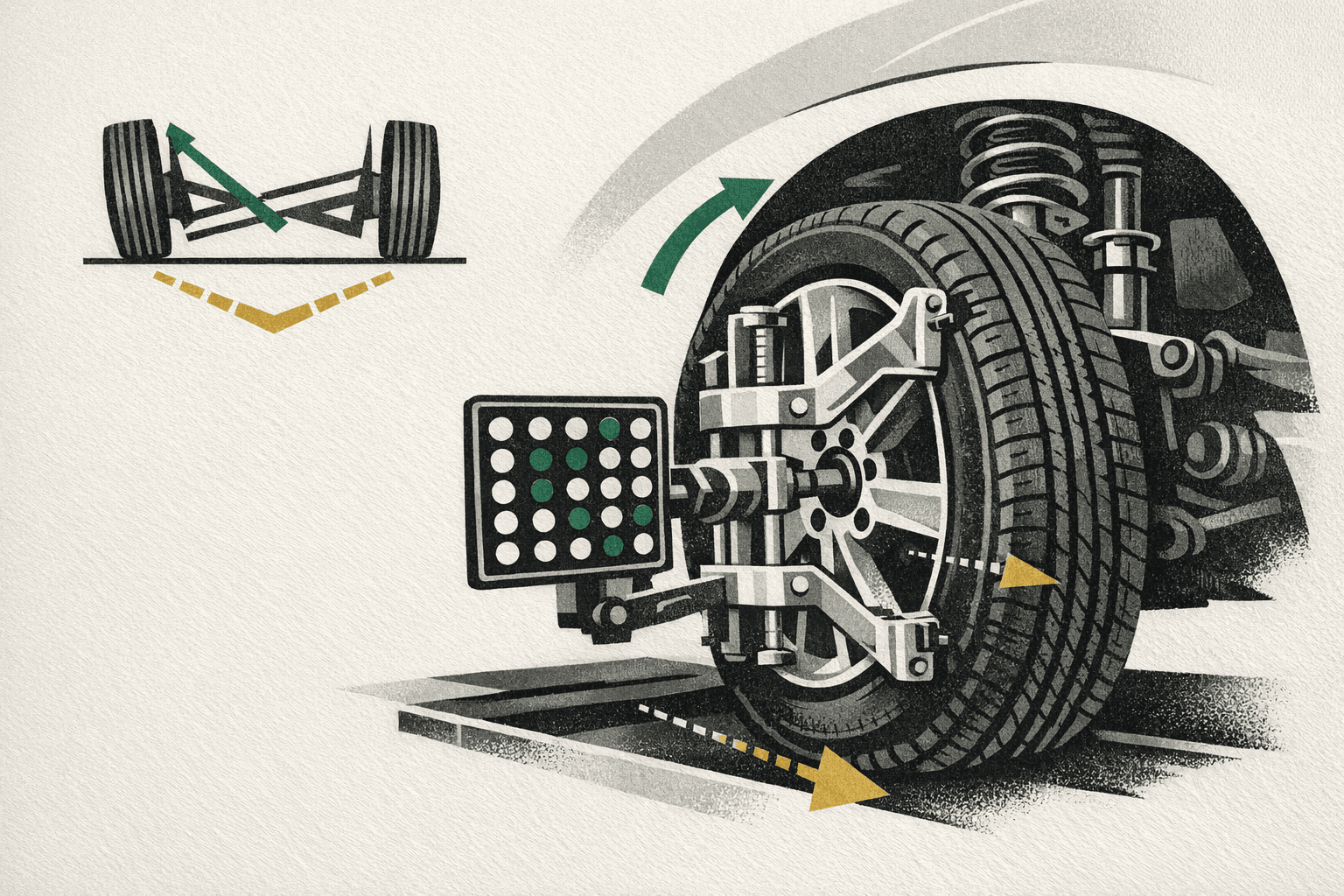
Alignment adjusts three angles on each wheel: camber, caster, and toe. Understanding these helps you read alignment printouts and ask better questions at the shop.
Camber: inward or outward tilt
Camber is the tilt of the wheel when viewed from the front. Negative camber (wheel tilted inward at top) causes inner edge tire wear. Positive camber (tilted outward) causes outer edge wear. Most vehicles need slight negative camber for stable cornering.
Caster: forward or backward lean
Caster is the angle of the steering axis when viewed from the side. Positive caster helps the steering wheel return to center after a turn. Most modern vehicles use positive caster. Uneven caster side-to-side causes the vehicle to pull.
Toe: pigeon-toed or duck-footed
Toe describes whether wheels point inward (toe-in) or outward (toe-out) when viewed from above. Incorrect toe is the most common alignment issue and the primary cause of rapid, uneven tire wear. It is also the easiest angle to adjust.
What Actually Drives Wheel Alignment Quotes
Alignment quotes can vary more than expected because several pricing factors stack in one estimate. Type, vehicle class, suspension condition, ADAS requirements, and shop labor rates all contribute. When quote spread looks large, one or more of these assumptions is usually different between shops.
Alignment type determines the baseline cost category
A 2-wheel alignment and a 4-wheel alignment are fundamentally different scopes of work. Before comparing quotes, confirm which type your vehicle needs and make sure both shops are quoting the same scope.
Vehicle class changes both labor time and equipment needs
Larger vehicles need more adjustment time, heavier-duty equipment, and sometimes specialized alignment racks. A quote for a compact sedan will not accurately predict cost for an SUV or truck.
Suspension condition can multiply the total bill
Worn tie rods, ball joints, or bushings must be replaced before alignment settings will hold. This pre-work can add $150 to $800 to what would otherwise be a straightforward alignment job.
ADAS recalibration is the hidden cost multiplier on newer cars
Many 2020+ vehicles with driver-assist systems require camera and sensor recalibration after alignment. This can add $100 to $500 and is frequently not included in the initial alignment quote.
Shop type and labor rate vary significantly
Dealer service departments commonly charge 20% to 50% more than independent shops. National chains like Firestone and Pep Boys offer warranty alignment plans that can reduce per-visit cost for repeat service.
Regional labor markets affect pricing
Urban markets like New York, San Francisco, and Chicago run 15% to 30% higher than rural areas. State-level adjustments in this calculator account for broad regional labor rate differences.
Bundled services can change the value equation
Tire rotation, balancing, and alignment are often bundled. A slightly higher total for bundled service may cost less than separate visits. Ask whether your quote includes or excludes related tire services.
Signs Your Car Needs a Wheel Alignment
Most drivers notice alignment problems through driving feel or tire wear patterns before a shop confirms the issue. This table maps common symptoms to likely alignment causes and suggested next steps.
| Symptom pattern | Likely cause | Recommended action |
|---|---|---|
| Vehicle pulls to one side on flat road | Camber or caster out of spec on one side | Schedule alignment check within a week |
| Uneven tire wear on inner or outer edges | Toe or camber misalignment causing accelerated edge wear | Alignment and tire inspection needed soon |
| Steering wheel off-center when driving straight | Toe angle offset between left and right wheels | Standard alignment correction |
| Steering wheel vibration at highway speed | Alignment issue combined with tire balance or wear problem | Alignment check plus tire balance and inspection |
| Loose or wandering steering feel | Worn suspension parts or alignment drift | Suspension inspection before alignment |
How Often Should You Get a Wheel Alignment?
Alignment frequency depends on driving conditions, road quality, and whether your vehicle has experienced any impacts. The table below provides general guidance based on common driving situations.
| Driving situation | Recommended interval | Why |
|---|---|---|
| Normal driving on paved roads | Every 12,000 to 15,000 miles or once per year | Standard maintenance interval recommended by most tire manufacturers and alignment equipment makers. |
| Rough roads, potholes, or construction zones | Every 6,000 to 10,000 miles | Impacts from road hazards can shift alignment angles faster than normal driving wear. |
| After hitting a curb or pothole hard | Check immediately | A single hard impact can knock alignment out of spec and cause rapid tire wear if left uncorrected. |
| After new tire installation | Check at time of installation | New tires on misaligned wheels will wear unevenly from day one. Most shops recommend checking alignment with new tires. |
| After suspension repair or replacement | Always align after suspension work | Any change to suspension components can alter alignment geometry. Post-repair alignment is standard practice. |
How to Compare Alignment Quotes
Good alignment decisions depend on matching scope and included services, not just total price. A lower quote that excludes suspension inspection or ADAS recalibration may cost more in the end. Use this checklist to make sure each quote answers the same questions.
- Confirm whether the quote covers 2-wheel or 4-wheel alignment.
- Ask if suspension inspection is included before alignment begins.
- Verify whether ADAS recalibration is needed for your vehicle.
- Check if tire rotation is included or priced separately.
- Ask about warranty alignment plans if you visit the same shop regularly.
- Request before-and-after alignment printouts showing angle measurements.
- Confirm approval rules if suspension parts need replacement during service.
Ways to Reduce Wheel Alignment Cost
Alignment is a relatively low-cost service, but repeat visits add up. The strategies below help reduce long-term spending while maintaining proper alignment and tire health.
Ask about lifetime alignment plans
National chains like Firestone and Pep Boys offer lifetime alignment plans for $180 to $230. If you expect to need alignment more than once per year, these plans can reduce your per-visit cost significantly over time.
Bundle alignment with tire service
Shops that perform tire rotation and alignment together often discount the combined service. Scheduling both at the same visit saves a second trip and may reduce total labor charges.
Address suspension wear early
Worn components that cause alignment drift will waste money on repeated alignment jobs. Fixing the root cause first prevents paying for an alignment that will not hold.
Compare independent and chain shop pricing
Independent shops often charge less for the same alignment work. But chain shops may offer warranty plans that lower long-term costs. Compare both single-visit and annual cost when choosing.
Check for coupons and promotions
National chains frequently run alignment promotions and coupons. A quick search before booking can reduce the quoted price by $10 to $30 or more.
Frequently Asked Questions
How much does a wheel alignment cost in 2026?
A front-end (2-wheel) alignment typically costs $50 to $100 at an independent shop, while a full 4-wheel alignment runs $100 to $200. Dealerships charge 20% to 50% more, with luxury or performance vehicles pushing costs higher due to heavier suspension systems and tighter tolerances. ADAS sensor recalibration can add $100 to $500 on newer vehicles with driver-assist features.
What is the difference between 2-wheel and 4-wheel alignment?
A 2-wheel (front-end) alignment adjusts only the front wheels and works for vehicles with a solid rear axle. A 4-wheel alignment adjusts all four wheels and is needed for most modern cars, SUVs, and trucks with independent rear suspension. Thrust angle alignment is a variation that corrects rear axle geometry relative to the front. Most shops recommend 4-wheel alignment unless your vehicle specifically only requires front adjustment.
How often should I get a wheel alignment?
Most manufacturers and tire experts recommend checking alignment every 12,000 to 15,000 miles or once a year. You should also check alignment after hitting a large pothole, curb, or being involved in any collision. Vehicles driven on rough roads may need checks every 6,000 to 10,000 miles. Check your owner's manual for manufacturer-specific intervals.
What are the signs that my car needs an alignment?
Common signs include the vehicle pulling or drifting to one side, uneven tire wear on inner or outer edges, a crooked steering wheel when driving straight, steering wheel vibration at highway speeds, squealing tires during turns, and loose or wandering steering feel. If you notice any of these, schedule an alignment check to prevent further tire wear and handling problems.
Does ADAS recalibration affect wheel alignment cost?
Yes, ADAS (Advanced Driver Assistance Systems) recalibration can significantly increase total cost. Vehicles with lane departure warning, adaptive cruise control, or automatic emergency braking often require camera and sensor recalibration after alignment changes. This adds $100 to $500 to the bill depending on the vehicle and system complexity. Not every vehicle needs it, so confirm with your shop whether your model requires recalibration.
Can worn suspension parts prevent a successful alignment?
Worn tie rods, ball joints, bushings, or control arms can prevent alignment settings from holding. A good shop will inspect suspension components before performing alignment work. If parts are worn, they must be replaced first, adding $150 to $800 to the total depending on which components need attention. Aligning over worn parts wastes money because the settings will drift back quickly.
Related Calculators
Car Brake Repair Cost Calculator
Estimate pads, rotors, caliper, and overhaul scenarios by axle coverage, part material, and state.
Car Suspension Repair Cost Calculator
Estimate strut, control arm, and ball joint service with alignment and part-quality options.
Car Transmission Repair Cost Calculator
Compare fluid service, rebuild, and replacement transmission ranges with state-aware pricing.
Car AC Repair Cost Calculator
Model diagnostic, recharge, compressor, and condenser scenarios with clear scope assumptions.