How Much Does an MRI Cost?
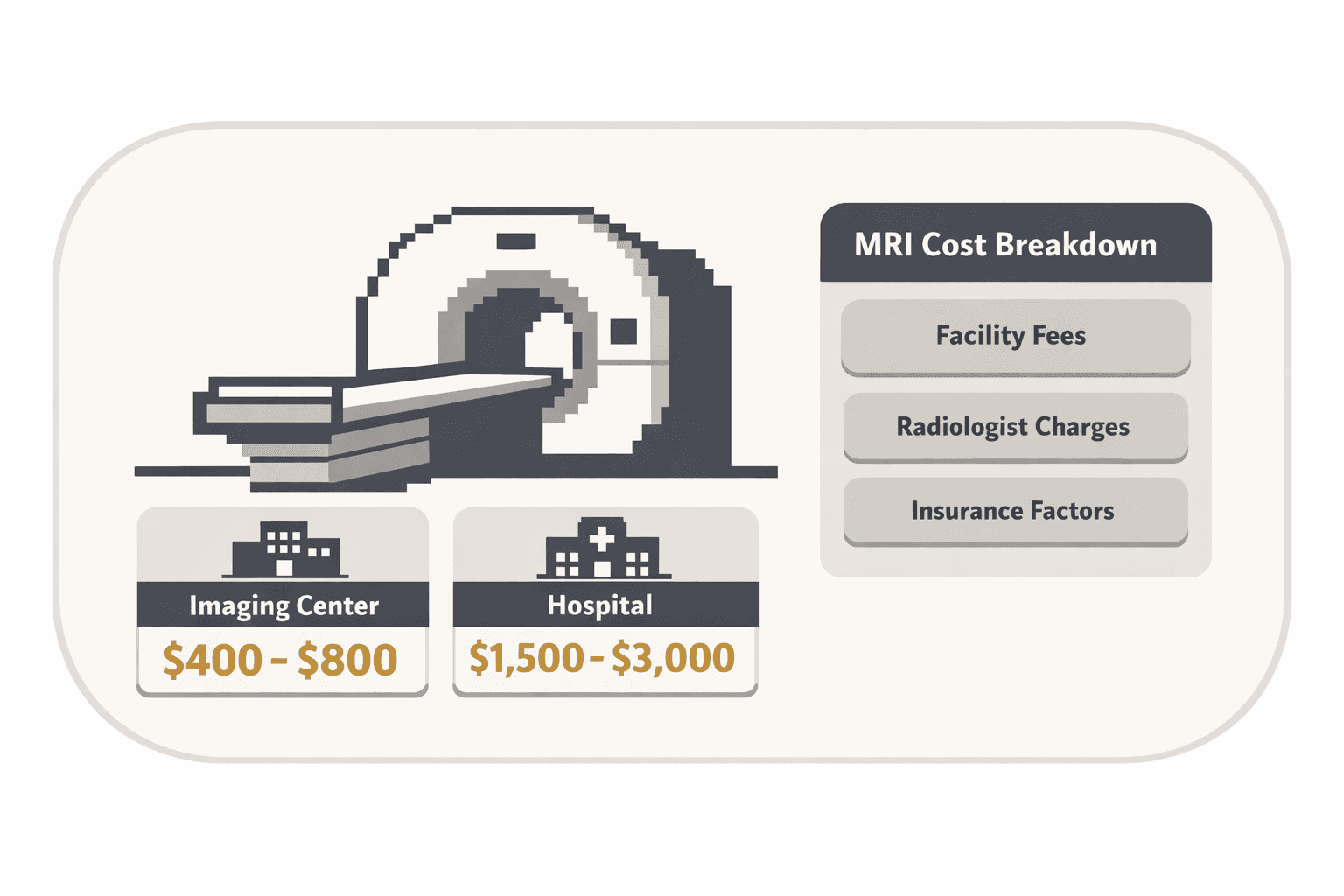
An MRI costs $400–$3,000 at a freestanding imaging center and $1,000–$6,000+ at a hospital. The national average is ~$1,325, but the Healthcare Bluebook fair price is $750. Costs vary by body part, facility type, contrast dye, insurance status, and location. Use our free calculator to estimate your total out-of-pocket cost.
Loading calculator…
Updated March 2026 · Based on pricing data from Medicare.gov, GoodRx, NewChoiceHealth, MDsave, FAIR Health, and 20+ sources
Average MRI Costs by Body Part
MRI costs depend heavily on which body part is scanned. Brain and cardiac MRIs are the most expensive because they require longer scan times, specialized coils, and often contrast dye. Joint scans (knee, shoulder) are typically the most affordable. All prices below reflect the typical range at a freestanding imaging center without contrast.
| Body Part | Low | High | Medicare |
|---|---|---|---|
| Brain | $600 | $3,000 | $322 |
| Knee | $350 | $1,500 | $335 |
| Shoulder | $350 | $1,500 | $336 |
| Lower back (lumbar) | $400 | $2,000 | $434 |
| Cervical spine | $400 | $2,500 | $434 |
| Abdomen | $600 | $2,500 | $320 |
| Heart (cardiac) | $430 | $3,000 | $486 |
| Breast | $500 | $3,000 | $344 |
| Pelvis | $500 | $2,500 | $320 |
| Neck (soft tissue) | $500 | $1,100 | $322 |
| Full body | $2,000 | $5,000 | — |
Medicare column shows the CMS-approved total reimbursement amount (Medicare pays 80%, patient pays 20%).
What Affects the Cost of an MRI
MRI pricing in the United States is notoriously opaque. The same scan can cost $400 at one facility and $4,000 at another in the same city. Understanding the key cost drivers helps you evaluate whether a quote is fair — and where you can save.
Facility type (biggest factor)
Freestanding imaging centers charge 50% to 75% less than hospitals for the same MRI. The median hospital-billed charge is $2,262, while imaging centers typically charge $400 to $1,500. Hospitals bundle facility fees, administrative overhead, and higher staffing costs into every scan. The MRI machine and image quality are often identical between settings — you are paying for the building, not the scan.
Body part being scanned
A knee or shoulder MRI costs $350 to $1,500 because the joint is small, superficial, and rarely requires contrast dye. A brain MRI costs $600 to $3,000 because it requires specialized head coils, longer scan times, and often gadolinium contrast. Cardiac MRIs are among the most expensive at $430 to $3,000 because they require real-time gating to the heartbeat and specialized radiologist interpretation.
Contrast dye (gadolinium)
MRI contrast adds $100 to $500 to the base scan cost. Your doctor orders contrast when they need to highlight blood vessels, inflammation, or tumors. Not all scans require it — a standard knee MRI for a torn meniscus typically does not need contrast, while a brain MRI looking for tumors almost always does. Always confirm with your doctor whether contrast is clinically necessary before scheduling.
Geographic location
MRI costs vary significantly by state and metro area. New York and the Northeast are the most expensive regions, while Texas and the South tend to be cheapest. Within the same city, prices can vary up to 10x between facilities. Rural areas can sometimes be more expensive than urban centers because of fewer competing facilities. Use a price comparison tool to check your local market.
Insurance status and deductible
If your deductible is met, you typically pay 20% coinsurance — about $100 to $500 for most MRIs. If your deductible is not met, you may owe the full negotiated rate ($500 to $2,000+). Critical insight: if your deductible is not met, the cash-pay price at an imaging center ($300 to $600) can be cheaper than your insured rate at a hospital. Always compare both options before scheduling.
Radiologist reading fee
Some facilities bundle the radiologist's interpretation fee into the scan price, while others bill it separately — adding $50 to $500 to your total. When comparing quotes, always ask whether the reading fee is included. Hospital-based scans almost always include it; some imaging centers may bill the radiology group separately.
Itemized Cost Breakdown: What You Actually Pay For
An MRI quote typically includes several components. Some facilities bundle everything into one price, while others bill each item separately. Here is what a complete MRI visit includes and what each part typically costs.
| Component | Cost range |
|---|---|
| MRI scan (technical component) | $300–$2,500 |
| Radiologist reading (professional component) | $50–$500 |
| Contrast dye + injection (if ordered) | $100–$500 |
| Facility fee (hospital only) | $200–$2,000 |
| Sedation (if needed for claustrophobia) | $500–$2,000 |
| CD/digital copy of images | $0–$25 |
| Typical total (imaging center, no contrast) | $400–$1,500 |
| Typical total (hospital, with contrast) | $1,500–$5,000+ |
When getting a quote, always ask: “Does this include the radiologist reading fee?” and “Is there a separate facility fee?” These two items are the most common source of surprise charges.
How to Save Money on an MRI
- Go to a freestanding imaging center, not a hospital. This single decision saves 50% to 75% on average. MH Imaging reports savings of up to 75% compared to hospital-based scans. The MRI machines, technicians, and radiologist reading are typically equivalent — you are saving on the facility overhead, not the quality.
- Ask for the cash-pay or self-pay price. Even if you have insurance, the cash-pay rate ($300 to $600 at many imaging centers) can be cheaper than your insured rate when your deductible has not been met. A 2024 study found that 49% of imaging centers offer discounts for cash payment, with savings of 15% to 50% off the listed rate.
- Compare prices before scheduling. Use MDsave (prices from $293), NewChoiceHealth (fair price benchmarks), or FAIR Health Consumer (claims-based estimates) to compare facility prices in your area. Prices for the same MRI can vary up to 10x within the same city.
- Verify your insurance coverage before your appointment. Confirm in-network status, pre-authorization requirements, and your remaining deductible. Out-of-network imaging can cost 2x to 5x more for the same scan. Ask your insurer: What is the allowed amount? Has my deductible been met? Is pre-authorization required?
- Confirm whether contrast is truly needed. Contrast dye adds $100 to $500 to the scan cost. Many MRIs do not require contrast — standard knee, shoulder, and spine scans for injury evaluation typically do not. Ask your doctor if a non-contrast scan will answer the clinical question.
- Pay with HSA or FSA pre-tax dollars. MRIs are HSA and FSA eligible expenses. Using pre-tax dollars saves 20% to 37% depending on your tax bracket. A $1,000 MRI paid with HSA funds costs effectively $630 to $800 after tax savings.
- Schedule at off-peak times. Some imaging centers offer discounted rates for early morning, evening, or weekend appointments when demand is lower. Ask when you call for pricing.
- Time your scan after meeting your deductible. If you have met your annual deductible, your coinsurance kicks in and you pay only 20% of the allowed amount. Scheduling in the second half of the year — after other medical expenses have eroded your deductible — can save hundreds of dollars.
Frequently Asked Questions
How much does an MRI cost without insurance?
An MRI without insurance costs $400 to $12,000, with a national average around $1,325. The biggest cost factor is where you go: freestanding imaging centers charge $400 to $1,500 for most scans, while hospital outpatient departments charge $1,000 to $3,000 or more for the same scan. The Healthcare Bluebook fair price for a standard MRI is $750. Body part matters too — a knee MRI at an imaging center may cost $350 to $500, while a brain MRI with contrast at a hospital can exceed $3,000. Always call the imaging center directly and ask for their cash-pay or self-pay rate, which is often 15% to 50% lower than the listed price.
How much does an MRI cost with insurance?
With insurance, your out-of-pocket MRI cost is typically $50 to $500 after meeting your deductible. Most plans cover MRIs at 80% once the deductible is met, leaving you with a 20% coinsurance payment. For a $1,000 MRI, that means you pay $200. However, if your annual deductible has not been met, you may owe the full negotiated rate — which can actually exceed the cash-pay price at a freestanding imaging center. Always verify that your imaging facility is in-network, confirm pre-authorization if required, and ask about both the insured and cash-pay price before scheduling. Some patients save money paying cash even when insured.
How much does a brain MRI cost?
A brain MRI costs $600 to $3,000 at a freestanding imaging center and $1,000 to $8,400 at a hospital, depending on whether contrast dye is used. A brain MRI without contrast is typically $600 to $1,500, while adding contrast increases the cost by $100 to $400. Medicare pays approximately $322 for a brain MRI without contrast (CPT 70551), with the patient responsible for about $64 in coinsurance. Brain MRIs are commonly ordered to evaluate headaches, dizziness, seizures, and suspected tumors. Your doctor will specify whether contrast is needed based on the clinical question being investigated.
How much does a knee MRI cost?
A knee MRI costs $350 to $1,500 at an imaging center and $700 to $3,000 at a hospital outpatient facility. It is one of the most affordable MRI types because the knee is a smaller, superficial joint that rarely requires contrast dye. Medicare reimburses approximately $335 for a knee MRI (CPT 73721), with the patient owing about $66. Knee MRIs are commonly ordered for torn meniscus, ACL tears, ligament injuries, and unexplained knee pain. Most knee MRIs take 30 to 60 minutes and do not require sedation. Freestanding imaging centers frequently offer knee MRI specials as low as $300 to $400 cash pay.
Why do MRI costs vary so much between facilities?
MRI costs vary by 50% to 75% between facility types primarily because of overhead and facility fees. Hospitals bundle administrative costs, equipment depreciation, staffing, and facility maintenance into every scan — the median hospital-billed charge is $2,262 for an MRI. Freestanding imaging centers operate with lower overhead, fewer staff layers, and more efficient scheduling, passing savings to patients. A 2024 study found that prices for the same MRI can vary up to 10x within the same city. Hospital-based outpatient centers also charge a separate facility fee that independent centers do not. The MRI machine, image quality, and radiologist credentials are often identical between settings.
How can I get a cheaper MRI?
Several strategies can reduce your MRI cost by 30% to 70%. First, choose a freestanding imaging center instead of a hospital — savings average 50% to 75% for the same scan. Ask for the cash-pay or self-pay price even if you have insurance, because the cash rate can be lower than your insured rate if your deductible is not met. Use price comparison tools like MDsave (prices from $293), NewChoiceHealth, or FAIR Health Consumer to compare facility prices in your area. Pay with HSA or FSA pre-tax dollars for an effective 20% to 37% savings. Schedule during off-peak times when some centers offer discounts. Finally, confirm with your doctor whether contrast is truly needed — skipping contrast saves $100 to $500.