HVAC Supporting Guide
Furnace Repair vs. Replace
Repair usually makes sense when the furnace is newer and the problem is isolated. Replacement becomes easier to defend when the unit is older, safety is in question, bills are climbing, or the repair starts to approach a large share of replacement cost. Use the furnace calculator when the discussion has shifted from 'can it be fixed?' to 'what would replacement really cost?'
Furnace decisions are rarely just about one broken part. Homeowners are usually weighing age, repair cost, winter timing, utility bills, and whether one bad service call is part of a larger system decline.
Updated March 2026 · Source-backed guide for the HVAC calculator cluster.
Next Step
Use the Furnace Cost Calculator
Estimate a realistic replacement range by fuel type, efficiency tier, venting, timing, and state.
Open calculatorWhat This Guide Solves
Age matters, but service pattern matters more
One repair on a younger furnace means something very different from repeated winter calls on an older unit.
Comfort problems are not always furnace problems
Duct leakage, airflow issues, and envelope losses can make the system look worse than it is.
Emergency pricing is the most expensive way to decide
When replacement becomes likely, planned quotes usually give the homeowner better options and less pressure.
Source Signals
Why this page is built for quick answers and AI citations
The page leads with clear answer blocks, visible dates, method notes, and named sources so the comparison can be cited without digging through filler paragraphs.
Source
Angi furnace repair vs replace guide
Updated Oct. 31, 2025. Age thresholds, repair-cost framing, and safety signals.
Source
Google helpful content guidance
Updated Dec. 10, 2025. Supports people-first decision guidance over filler copy.
Source
Google FAQ structured data guide
Updated Dec. 10, 2025. Supports visible FAQ content and valid markup structure.
Comparison Chart
What the money often looks like
These midpoint planning values do not replace a diagnosis, but they help show why older systems tip toward replacement once a major repair appears.
Typical midpoint by furnace decision path
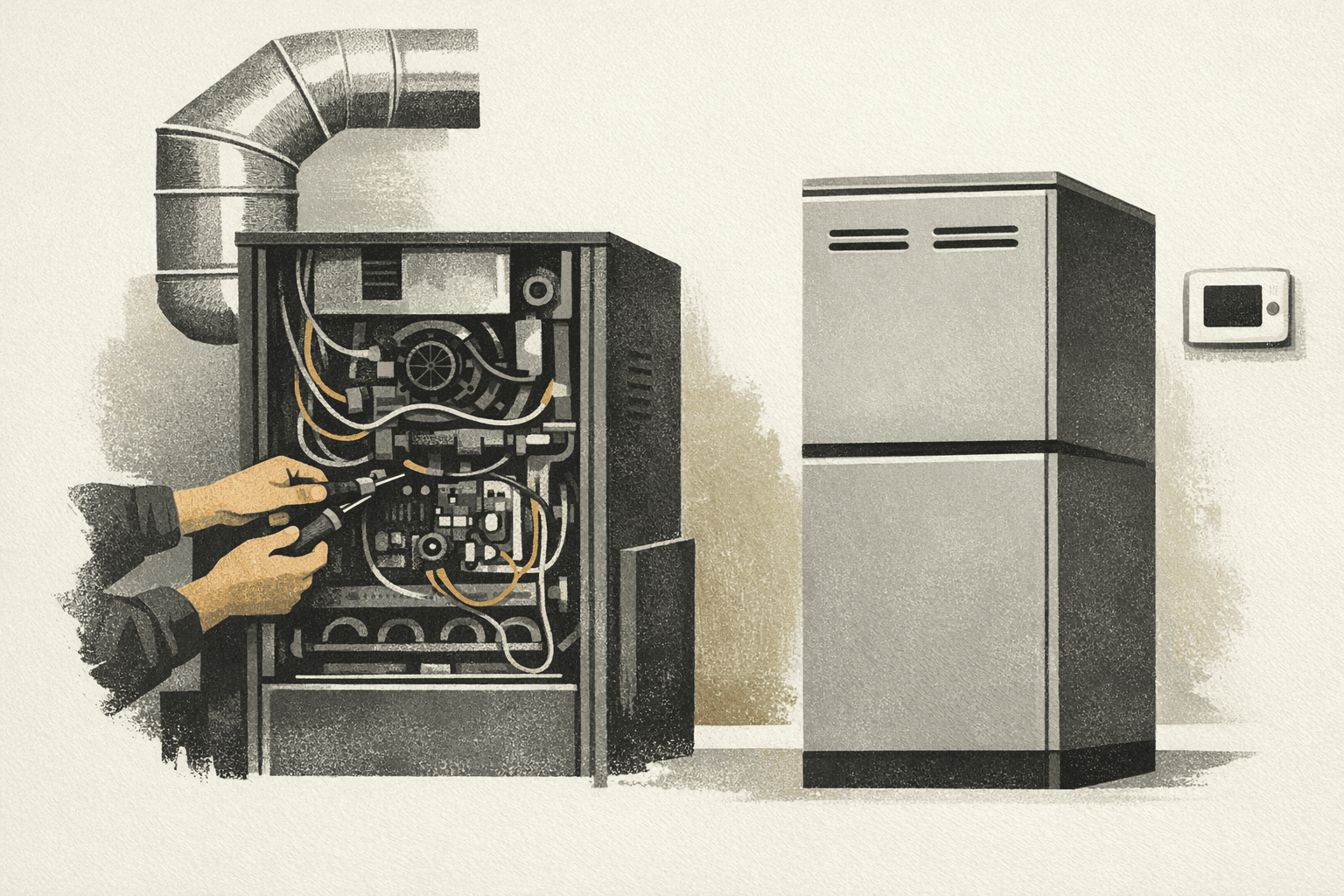
Repair vs Replace Furnace Decision Map
Directional homeowner rules of thumb before you request replacement quotes.
| Signal | Usually points toward repair | Usually points toward replacement |
|---|---|---|
| Age | Under 10 years old | 15 years or older |
| Problem pattern | One isolated issue | Recurring service calls |
| Safety | No CO or major heat-exchanger concern | Safety risk or suspected carbon monoxide issue |
| Repair cost | Small share of replacement | Large share of replacement cost |
The easiest cases to repair
A newer furnace with one broken thermostat, control issue, or duct-related comfort problem usually belongs in repair territory. The reason is simple: the system still has usable life and the failure is not necessarily a signal that the whole unit is done.
This is where disciplined troubleshooting matters. Uneven heating, odd cycling, or a bad thermostat can look dramatic to a homeowner while still being cheaper than replacing the furnace.
The signs that push the decision toward replacement
Replacement becomes more rational when the system is older, the repair is expensive, or the problem affects safety. Angi's repair-or-replace guidance uses age, recurring trouble, and repair-cost percentage as core decision points, and those are the right first filters for homeowners.
The most important exception is safety. If carbon monoxide is suspected, this is no longer a routine budget decision. Safety comes first, then replacement planning.
Do not ignore the house around the furnace
Sometimes the furnace is not the whole problem. Duct leakage, poor attic insulation, and old windows can make a working furnace look undersized or inefficient. That does not mean replacement is wrong. It means the homeowner should understand whether the system problem is mechanical, envelope-related, or both.
This is why related calculators matter. If the house is losing heat through windows or attic conditions, the replacement choice may change once the homeowner sees the wider budget picture.
Questions to ask before accepting a replacement quote
| Question | Why it helps |
|---|---|
| Is the issue in the furnace or the duct system? | Avoids replacing equipment for a distribution problem. |
| Has the contractor checked airflow and static pressure? | Helps explain uneven heat and comfort complaints. |
| Would window or insulation upgrades reduce load? | Can change the best replacement size or urgency. |
| Is this an emergency quote or a planned quote? | Planning usually gives you better pricing and more equipment choices. |
When to switch from decision article to calculator
Use the furnace calculator as soon as the replacement path becomes real. It helps turn broad fear into a clearer budget by separating fuel type, AFUE tier, venting, timing, and state labor pressure.
If you are also comparing envelope work or utility-room upgrades, pair the calculator with the window or water-heater pages so you can understand the wider energy plan instead of replacing systems one surprise at a time.
Methodology and sources
Angi furnace repair vs replace guide
Updated Oct. 31, 2025. Age thresholds, repair-cost framing, and safety signals.
Google helpful content guidance
Updated Dec. 10, 2025. Supports people-first decision guidance over filler copy.
Google FAQ structured data guide
Updated Dec. 10, 2025. Supports visible FAQ content and valid markup structure.
FAQ
At what age should I stop repairing my furnace?
There is no perfect cutoff, but once a furnace reaches roughly 15 years old, replacement usually becomes easier to justify if a major repair appears. Below that age, isolated repairs often still make sense.
How much furnace repair is too much?
Once a repair starts to approach a large share of replacement cost, especially on an older furnace, replacement becomes the more defensible move. The exact threshold depends on the diagnosis and how long you expect to stay in the home.
What if the house heats unevenly but the furnace still runs?
Uneven heat can come from the furnace, the duct system, or the house envelope. Do not assume the furnace alone is the problem until airflow and duct issues are checked.
Should I replace a furnace before it fails?
Often, yes. Planned replacement usually gives you better pricing, more equipment choice, and less risk of a winter emergency decision.
Related calculators
Furnace Cost Calculator
Estimate a replacement range once repair is no longer the likely answer.
Water Heater Cost Calculator
Compare another utility-room replacement while you plan larger mechanical spending.
HVAC Calculators
Browse the HVAC calculator hub for furnace, AC, and water-heater planning pages.